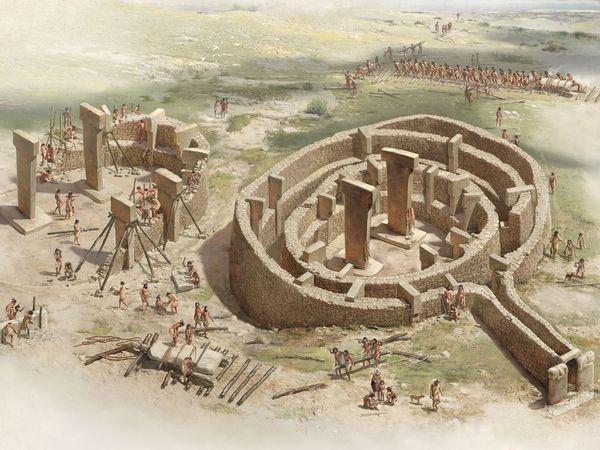
For my end of course assignment this semester, we were to compile a research paper detailing an place of interest before the 15th century. At first, I was mainly interested in doing a mythical place such as Atlantis or the lost continent of Lemuria – both have a rich history, but mostly based in fantasy and speculation. I realized that I needed something much more concrete, and so I made my own discovery of Gobekli Tepe.
Essentially, Gobekli Tepe is a archaeological discovery by German Archaeologist, Klaus Schmidt. In 1994, he was working in Turkey and visited the area after reading a report by researchers from the 1960s that had concluded nothing of interest. Fortunately, by luck or perhaps ambition, Schmidt delved deeper into the mystery and with his team, realized there was much more than meets the eye.

The research has been incredible to date as Schmidt and his team come upon the 20th anniversary of Gobekli Tepe’s discovery. Over the course of the several months I spent researching through excavation reports, research papers, and archaeological findings, it has become very evident that I believe something truly ground breaking is here despite conjectures of what others may believe. Older than Stonehenge, and even older than the Pyramids by radiocarbon dating evidence, it is amazing to think how much of history we really do not know about.
The biggest importance of this discovery is that archaeologists believe that Gobekli Tepe may be the oldest ceremonial center in history due to pillars with engravings of animal deities found within the excavation site which ultimately raises more questions than answers relating to the history of the human race because if Gobekli Tepe was believed to have been built somewhere in the Neolithic Era around 8,000-12,000 B.C, then what else could there be? Not to mention the fierce stigma towards human history at this point where humans only traveled the Earth in nomadic tribes for the majority of this time period.

To conclude, this was a very enjoyable assignment that I spent several months compiling into a research paper. I’ve uploaded it on Scribd and will be available via a link below. However, keep in mind when reading that this paper should be regarded as a brief inference of Gobekli Tepe, and any individual displaying a deep interest in this discovery should investigate the research reports compiled by Klaus Schmidt and his team.
 Memory Reflection
Did you know that Göbekli Tepe means ‘potbellied hill’ in Turkish; I wonder who named it. Anyway, I didn’t even know that plave existing in my country. I think it’s pretty interesting. Well done.
This is fscinating..i want to read more about it for certain!